
 In stock
LOT VRX-26-0077
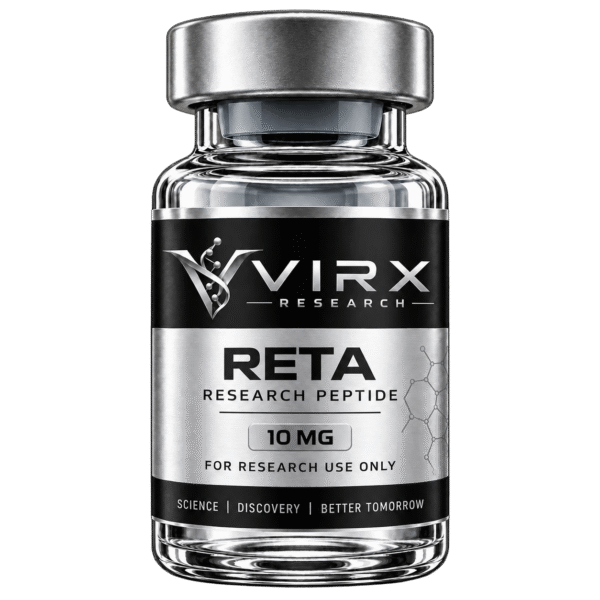
Hover to magnify
Reta
Research product with selectable vial and pack options.
FormatLyophilised vial
Sequence ref10mg · Single vial · 10mg · Kit of 10
StorageCool · dry · dark
$45.00
$4.50 / mg · 10mg vial
In stock — dispatched within 24h
For laboratory research use only. Not for human or veterinary use. Not a drug, food or cosmetic. Handling should follow your institution's standard operating procedures.
Batch COADocumentation ready
Sealed vialsTamper evident
24h dispatchTracked delivery
Product description
Retatrutide (RETA) Research Peptide
Retatrutide, commonly referred to as RETA, is an investigational research compound developed for the study of metabolic signaling and multi-receptor agonism.
Retatrutide is distinguished by its activity at three hormone receptor systems: glucose-dependent insulinotropic polypeptide (GIP), glucagon-like peptide-1 (GLP-1), and glucagon receptors. This triple-receptor profile has made retatrutide an important subject of current metabolic and endocrinology research.
Key Research Features
- Retatrutide / RETA research compound
- Triple GIP, GLP-1 and glucagon receptor agonist
- Designed for controlled laboratory research
- Suitable for metabolic signaling research
- Batch-specific identification where provided
- Certificate of Analysis available where applicable
- Clearly labeled for research use only
- Secure packaging designed to support product integrity
Research Applications
Retatrutide is being investigated in research involving:
- GIP receptor signaling
- GLP-1 receptor signaling
- Glucagon receptor signaling
- Multi-receptor agonism
- Cellular metabolic pathways
- Energy-homeostasis mechanisms
- Glucose-related signaling pathways
- Endocrine signaling
- Metabolic pathway research
- Structure-activity relationship studies
These areas describe scientific research interests and should not be interpreted as approved therapeutic indications.
Triple Receptor Research
Retatrutide differs from compounds that primarily target a single receptor because it has been designed to activate three distinct receptor pathways.
Researchers are investigating how simultaneous GIP, GLP-1, and glucagon receptor activity influences downstream metabolic signaling and how these pathways interact under controlled experimental conditions.
This multi-receptor mechanism has made retatrutide particularly relevant to studies examining complex endocrine and metabolic signaling systems.
About Retatrutide
Retatrutide is also identified by the development code LY3437943.
It is currently an investigational compound undergoing clinical development and research. It should not be represented as an FDA-approved medication or commercially approved treatment.
The informal term “GLP-3” is sometimes used online to describe retatrutide, but this is not its scientific classification. Triple receptor agonist is the more accurate terminology.
Quality & Documentation
Reliable laboratory research depends on accurate identification, consistency, and traceability.
Retatrutide should be supplied with appropriate batch information and analytical documentation where applicable. Researchers should review the product-specific Certificate of Analysis to confirm characteristics such as identity, purity, and composition.
Only include specific purity percentages or testing claims on your product page when they are supported by the actual batch COA.
Storage
Store Retatrutide according to the storage instructions provided with the specific product.
Protect research material from excessive heat, moisture, and direct light. Storage requirements may vary depending on the supplied formulation and laboratory protocol.
Research Use Only
Retatrutide (RETA) is offered strictly for laboratory, analytical, and scientific research purposes.
Not for human consumption. Not for veterinary use. Not intended to diagnose, treat, cure, or prevent any disease or medical condition.
Retatrutide remains an investigational compound and is not currently FDA-approved.
Purchasers are responsible for ensuring that the material is handled by appropriately qualified personnel and used in accordance with applicable laws, regulations, and laboratory procedures.
PresentationLyophilised vial, labelled with product details and lot reference.
Intended useLaboratory research applications only, handled by qualified personnel.
Lot referenceVRX-26-0077
COA & batch documentation
Documentation is filed against the lot reference printed on the vial.
Certificate of analysis — VRX-26-0077Upload the COA in Product Customiser
HPLC chromatogramAdd the HPLC URL in the WooCommerce product editor
Handling & storage sheetAdd the handling URL in the WooCommerce product editor
Research information
Vial Size10mg · Single vial, 10mg · Kit of 10, 20mg · Single vial, 20mg · Kit of 10, 30mg · Single vial, 30mg · Kit of 10
Shipping & returns
Order processingOrders are prepared promptly after payment confirmation.
DeliveryTracked dispatch with protective packaging.
ReturnsSealed, unopened products may be eligible for return according to your store policy.
Damaged parcelsContact support promptly with parcel photographs.
Laboratory feedback
No published reviews for this compound yet.
Related